
Japanese Name Generator
Find the perfect name that matches personality, mood, and style.
If you’ve been watching anime or studying Japanese, you’ve probably noticed people rarely call each other by their full names. Instead, they use all sorts of modified versions with special endings attached. For instance, Ai Scream’s latest song, called “愛♡スクリ~ム!”, consistently uses the end “-chan.”
In this post, we’ll talk about Japanese nicknames and the special endings you can actually use to show your relationship. We’ll also add some tips about their usage so it won’t sound awkward when you try them out.
Fun Fact
Did you know that the suffix -tan actually originated from “baby talk”? It is a mispronunciation of -chan by toddlers who couldn’t quite master the “ch” sound. Eventually, the “moe” and “otaku” subcultures in Japan adopted it to describe characters or idols they find incredibly adorable and precious, turning a linguistic mistake into a cultural phenomenon!
Understanding Japanese Nicknames vs. Honorifics
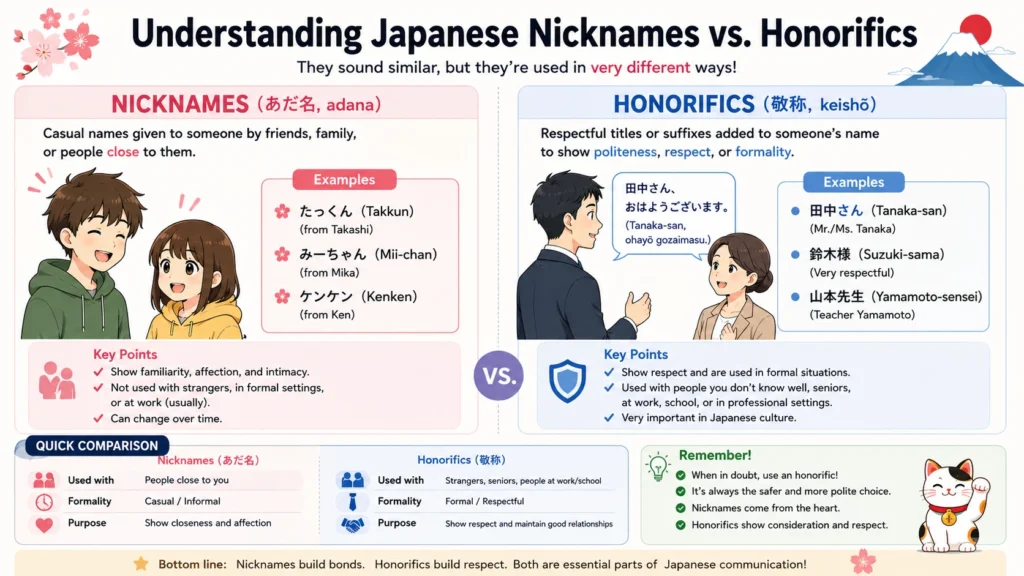
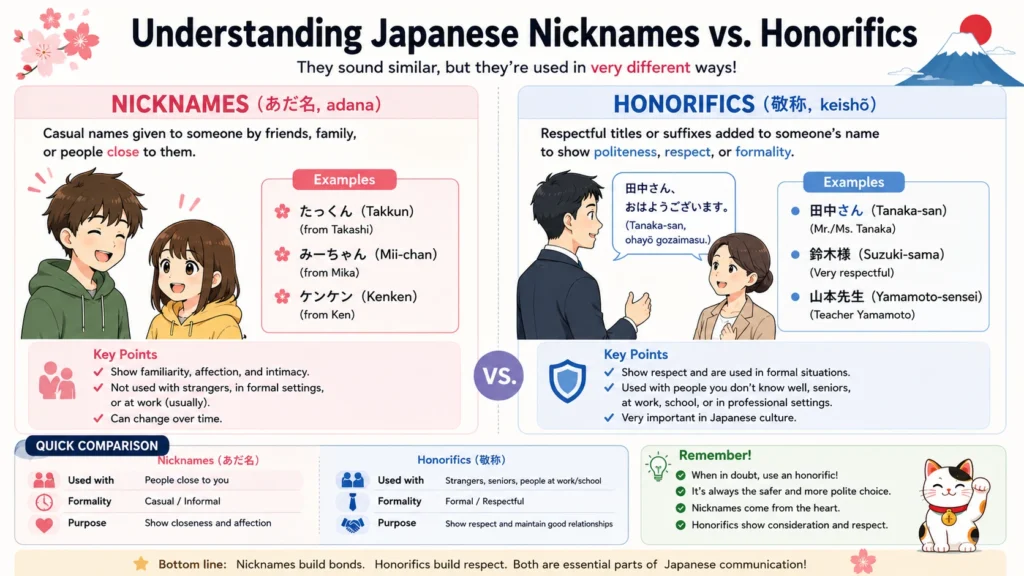
In Japan, honorifics like -san act as a social safety net, providing a level of polite distance between speakers. Nicknames, however, break down these barriers. While honorifics are mandatory in professional or formal settings, nicknames are reserved for family, close friends, or romantic partners. The transition from using a last name with -san to a cute nickname is a major milestone in a Japanese friendship.
| Nickname | Meaning | Origin / Pattern |
| Yuki-chan | Little Snow | First name (Yuki) + -chan |
| Haru-kun | Dear Spring | First name (Haru) + -kun |
| Mochi | Soft Rice Cake | Metaphor for soft cheeks |
| Momo-rin | Little Peach | First name (Momo) + -rin |
| Kayo-cchi | Dear Kayo | First name (Kayo) + -cchi |
| A-chan | Little “A” | First initial + -chan |
| Rina-tan | Darling Rina | First name (Rina) + -tan |
| Taka-chin | Precious Taka | First name (Taka) + -chin |
| Hime | Princess | Term of endearment |
| Miku-pon | Playful Miku | First name (Miku) + -pon |
Common Nickname Formation Patterns in Japanese
Creating a cute Japanese nickname is almost like a linguistic puzzle. The most common method involves shortening the original name and adding a Rhythmic suffix. For example, a name like “Nanami” might become “Nana-chan” or “Nami-rin.” This process, known as “mora-based clipping,” focuses on the musicality of the sounds. In Japanese culture, names with two syllables (or “moras”) are considered the most balanced and easy to say. By mixing and matching prefixes with different endings, you can create a nickname that fits the specific personality of your friend while adhering to the kawaii aesthetic that is so popular in modern Japanese society.
| Nickname | Meaning | Origin / Pattern |
| Sora-kun | Dear Sky | Name (Sora) + -kun |
| Hana-chan | Little Flower | Name (Hana) + -chan |
| Yui-yui | Double Yui | Reduplication of name |
| Koko | Heart/Small | Shortened “Kokoro” |
| Aki-pyon | Bouncy Aki | Name (Aki) + “Pyon” (hop) |
| Ken-ken | Strong Ken | Reduplication of name |
| Mi-tan | Darling Mi | Shortened “Mio/Mika” + -tan |
| Ryu-chan | Little Dragon | Name (Ryu) + -chan |
| Nico | Smile | Derived from “Niconico” |
| Sato-chi | Wise Little One | Name (Satoshi) + -chi |
Creative Japanese Nickname Endings
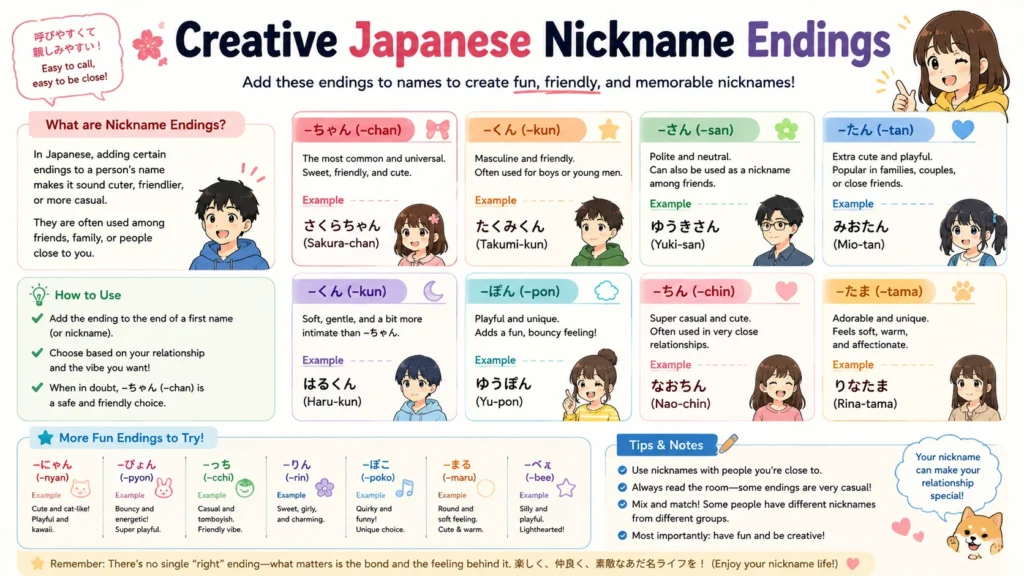
Beyond the basics, there are a variety of creative endings that add different “flavors” to a name. The ending -cchi (popularized by Tamagotchi) adds a trendy, pop-culture feel, while -rin and -n provide a soft, melodic finish that is very popular among young girls. For something extra sweet, -tan or -chin are used to imply a childlike innocence. These endings are not just random sounds; they carry specific emotional weights. Using -rin might make someone sound graceful, while -cchi makes them sound like a fun, energetic “buddy.” Experimenting with these creative endings is a great way to personalize your interactions and show off your Japanese language skills.
| Nickname | Meaning | Origin / Pattern |
| Lisa-cchi | Trendy Lisa | Name (Lisa) + -cchi |
| Yumi-rin | Bell-like Yumi | Name (Yumi) + -rin |
| Maki-n | Soft Maki | Name (Maki) + -n |
| Tomo-chin | Cute Tomo | Name (Tomomi) + -chin |
| Kaa-kun | Little Kazu | Shortened (Kazu) + -kun |
| Eri-pon | Sweet Eri | Name (Erika) + -pon |
| U-chan | Little U | Initial (Umi/Usagi) + -chan |
| Shi-tan | Darling Shi | Shortened (Shiori) + -tan |
| Nao-chi | Dear Nao | Name (Naoko) + -chi |
| Mai-mai | Dancing Mai | Reduplication of “Mai” |
How Often Do Japanese People Use Nicknames?
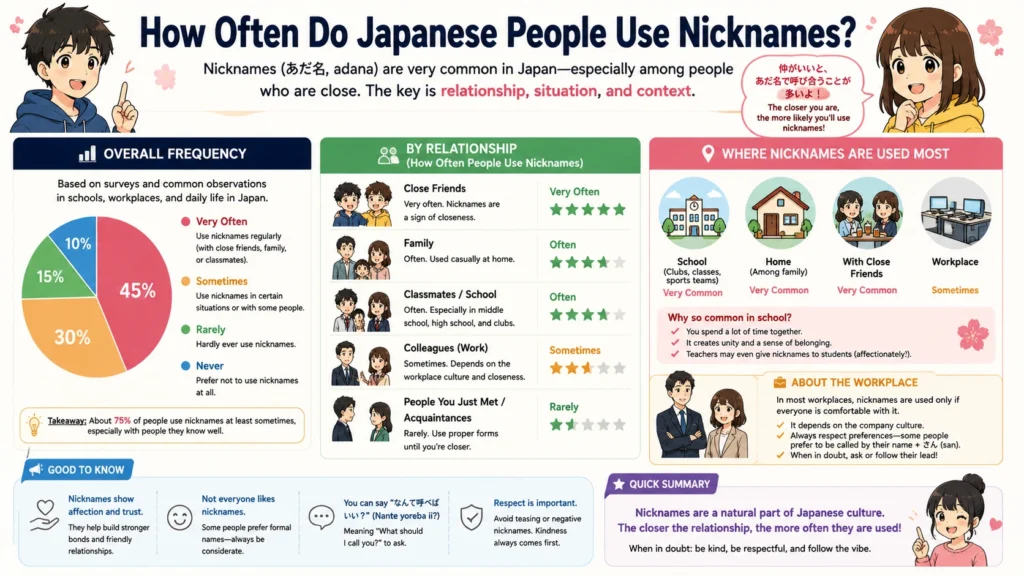
In everyday life, the frequency of nickname usage depends heavily on age and social environment. Among elementary and high school students, nicknames are the standard form of address within friend groups. However, as Japanese people enter the workforce (the “shakaijin” phase), they often revert to using last names with -san to maintain Professionalism. Even so, in private “nomikai” (drinking parties) or among longtime hobby groups, nicknames persist as a way to relax and “let one’s hair down.” It’s important to wait for a signal—or “nickname permission”—before jumping into using a cute name for someone older or in a superior position to avoid appearing disrespectful.
| Nickname | Meaning | Origin / Pattern |
| Aniki | Big Brother | Informal/Cool sibling term |
| Ane-san | Big Sister | Respectful yet close |
| Darling | Darling | Katakana English (Daarin) |
| O-jou | Young Lady | Often used for “princess” types |
| Sensei | Teacher | Used playfully for “know-it-alls” |
| Sho-kun | Bright Boy | Name (Sho) + -kun |
| Nana-chan | Seven/Nana | Name (Nana) + -chan |
| Yuu-cchi | Gentle Yuu | Name (Yuuto) + -cchi |
| Rara | La-La | Phonetic cute sound |
| Koto-rin | Small Harp | Name (Kotone) + -rin |
Final Thoughts
Cute Japanese nicknames are more than just playful variations of a person’s name—they reflect closeness, affection, and social connection. In Japanese culture, the way you address someone can reveal the level of trust and Familiarity you share. From classic endings like “-chan” and “-kun” to creative Modern styles such as “-tan,” “-rin,” and “-cchi,” each nickname carries its own emotional tone and personality.
However, timing and context matter. Using a nickname too quickly in formal situations may feel disrespectful, while using the right nickname among close friends can instantly create comfort and familiarity. That balance between politeness and intimacy is one of the most unique aspects of Japanese communication.
FAQs
What are cute Japanese nicknames?
Cute Japanese nicknames are affectionate or playful variations of a person’s name commonly used among friends, family members, romantic partners, or classmates. They are often created by shortening a name and adding endings like “-chan,” “-kun,” or “-tan.” These nicknames help express closeness, warmth, familiarity, and emotional connection in Japanese culture and everyday communication.
Why do Japanese people use nickname suffixes?
Japanese nickname suffixes show relationship dynamics and emotional tone. Endings like “-chan” express cuteness or affection, while “-kun” is often used for boys or close male friends. Creative endings such as “-rin” or “-cchi” add personality and style. These suffixes make conversations feel friendlier and help strengthen social bonds between people.
Is it okay for foreigners to use Japanese nicknames?
Yes, foreigners can use Japanese nicknames, but understanding social context is important. Nicknames are usually reserved for close relationships, so using them too quickly may sound overly familiar or disrespectful. It’s best to wait until someone gives permission or naturally develops a closer connection before using a cute or personalized nickname regularly.
What is the difference between “-chan” and “-kun”?
“-Chan” is commonly used for children, close female friends, pets, or loved ones to express sweetness and affection. “-Kun” is more often used for boys, younger males, classmates, or junior coworkers. While both are friendly suffixes, “-chan” sounds cuter and softer, whereas “-kun” carries a more casual but respectful tone.
Are Japanese nicknames inspired by anime culture?
Anime has helped popularize Japanese nicknames worldwide, but these naming styles existed long before anime became famous. Many anime characters use suffixes like “-chan,” “-kun,” and “-tan” to show personality and relationships. In real life, Japanese people also use similar nickname patterns in schools, friendships, families, and online communities every day.